
PARENT GUIDE #4
Fair vs. Unfair
Welcome to your final parent guide of the program! Over the last several weeks we’ve noticed skin color, defined racism, found points of conneciton, examined single stories, chaallenged stereotypes, centered BIPOC voices and experiences, and examined Whiteness. Now it’s time to explore a word we are certain you hear in your home: fair. It’s critical for our kids to understand more about fairness while building their understanding of race. Fairness, equality, and equity are terms that are thrown around in schools, homes, and communities. Our kids deserve to understand these powerful terms and explore what it means to improve things that are unfair.
You might be exhausted by your kids bellowing the phrase “That’s not fair!” Research suggests that children start to notice social norms around fairness as early as 12 months old. However, fairness can mean many different things in many different contexts, especially to a little one.
Fairness is not absolute, nor should it be. What’s ‘fair’ in one situation won’t be in another, and what’s ‘fair’ for one child won’t be for another. Our children pay close attention to fairness and have an innate desire for fairness for themselves and others. Knowing this, we can guide them towards understanding and building racial equity.
In exploring this parent guide, we’ll wonder: “What’s fair?, what’s unfair? And why?” We’ll start open-ended conversations with our kids with these questions as we explore instances of racial injustice in books and in our communities.
Just like when we talk about race and difference, when we talk about fairness we want to avoid immediately correcting any assumptions our child might have. Instead, invite conversations about fairness in relation to race and listen to your child’s observations and assumptions. Be open and inquisitive, and gently guide their thinking with questions.
Books

Pre-K Book:
Thao
Written & Illustrated by Thao Lam
Elementary Book:
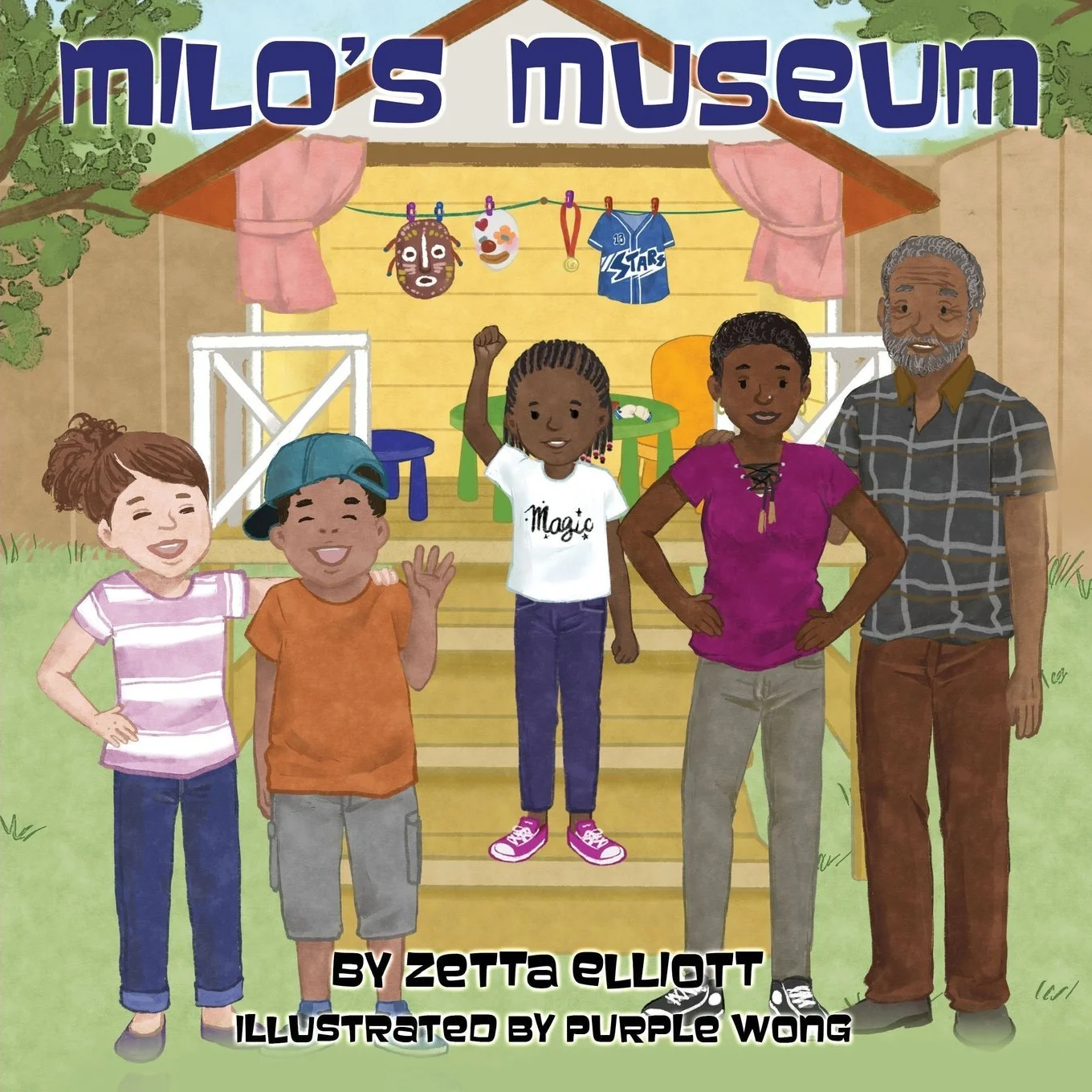
Milo’s Museum
Written by Zetta Elliott and Illustrated by Purple Wong
Identity Statement:
We are a family who supports safety, freedom, and dignity for every human being. We believe it is fair when all humans have these and unfair when any person or group takes this from any human. We work to notice and name when people do not have these.
Bookmarks:
Check out more books!
Why this Matters:
Kids often think that differences between racial groups are based on internal characteristics, as opposed to external and structural causes. We need to help our kids see the larger picture of equity by teaching them to identify external causes of inequity. For example, Suzy observes that Phillip (a child at her school with a different racial background) doesn’t have a lot of money. She’s been told by her parents that people have money because they work hard, so Suzy may jump to the biased conclusion that Phillip is poor because he doesn’t work hard (laziness = internal characteristic). Based on this biased information, Suzy may eventually come to believe that is is fair for people of a different race to be poor, because if they wanted more money they could just work harder. Suzy hasn’t had her biased beliefs interrupted with information about structural (external) inequities, i.e., that systems and policies disadvantage some people and privilege others. Those systems and policies can be invisible, especially to White children, if they are not talked about or explained.
What the Research says:
Children tend to think that wealth has to do with internal forces (who a person is on the inside) rather than external forces (systems, access, and other people).
Researchers wanted to understand what children think about wealth disparities. Children notice socioeconomic differences between White and Black neighborhoods. Researchers wanted to know what children think caused these disparities. They asked the children why they thought White kids often live in grand houses and Black kids often live in simple houses. Children’s explanations referenced people’s insides (their intelligence, abilities, or work ethic) rather than their outsides (their treatment by others, experiences, histories, or income). Children who thought White children lived in grander houses because White people were intrinsically better deep inside showed greater racial prejudice, compared to children who understood that White children often lived in grander houses because of external, structural reasons.
Want to read more?
Shutts, K., Brey, E.L., Dornbusch, L.A., Slywotzky, N. & Olson, K.R. (2016). Children use wealth cues to evaluate others. PloS ONe, 11(3), e0149360.
Do’s and Don’ts
DO: Take opportunities to discuss and question rules, authority, and the different community spaces you inhabit. Help your children distinguish between spaces that provide equity and spaces that are inequitable.
DO: Share experiences and history that have given White families unfair advantages. Connect those to wealth, housing, education, healthcare, etc. Make sure to share your feelings and talk about those inequities as wrong and unfair.
DO: Teach your children about economics. Share where money comes from and how things are paid for in your home. Children need context and real-life examples to be able to spot wealth inequities. For example, “I have to go to work because our groceries cost money. When I go to work, I get paid with money that helps to take care of our family.” Lack of knowledge about economics can lead kids to make meaning about race and socioeconomic status that is biased.
DO: Explain that not all rules are fair. Explain that there are rules that help some people and harm others.
DO: Share past and present examples of racial injustice. Kids need to understand that racism is happening today.
DON’T: Connect a person’s wealth to their intelligence, work ethic, or value. For example, “We live in a nice house because we work hard” ignores the many factors that contribute to wealth, as well as the reality that many people work hard and do not live in nice houses.
DON’T: Make false or general statements about unjust systems. For example, “The police are here to keep everyone safe.” While it might be true that the police in your community keep your family safe, it is important for your children to know that not all communities and people are protected equitably by the police.
What you or your kids may ask:
“What is the difference between fairness, equality, and equity?”
Fairness is a concept that is grounded in perception; therefore it isn’t easy to define concretely. Fairness is studied in depth in fields like economics, sociology, and psychology. Many studies find that children have an inclination towards “fair” outcomes from an early age, but what is fair is determined by their developmental stage, social norms, circumstances, environment, and more. See these peer-reviewed studies published in Frontiers in Psychology and PLos ONE.
Equality is the idea that everyone should be allocated the same quantity of resources. Many children’s early understanding of fairness connects to equal distribution of resources, and many adults also hold to the definition of fair as equal. Defining fairness as equal distribution is promoted in the dominant (i.e., White) culture, and this messaging is reinforced in homes, schools, workplaces and more.
Equity is a more complex and robust way to view fairness, and more appropriate for the complex systems we live in. Equity implies giving each individual what they uniquely need to achieve similar “fair” outcomes. Equity can be more challenging to explain and understand . Equity asks us to distribute different amounts based on individual needs. It asks us to understand that some people won’t “get,” but will need to “give” or “give up.” The key concept is that everyone ends up with what they need.
Equity may be in direct contrast to your or your child’s current understanding of fairness. Kids and adults need practice identifying examples of equity and inequity. The systems and structures in place in our country are often built to keep certain groups safe and comfortable. If you have White skin privilege, you have been given an unfair advantage - an advantage you did not earn but were born into. This privilege doesn’t mean your life has been easy; it means that your life has not been made harder because of your skin color. If you are a BIPOC family, you have likely encountered many of the ways our society creates disadvantages for BIPOC individuals. Depending on their ages, your kids have likely been taking in and making meaning of the ways in which they see White people’s unearned advantages. This can lead to internalized racism if it isn’t talked about and challenged.
We need to talk to our kids about how our country and communities would look and feel if they were truly equitable. You might have seen this image. (PNG of image in folder - please include the actual image on the site)
We encourage you to read this article about why this infographic still has inherent challenges in explaining equity, and then talk to your children about how they might define equity in an illustration.